NPCIL installs 320-tonne reactor pressure vessel at Kudankulam Unit-5
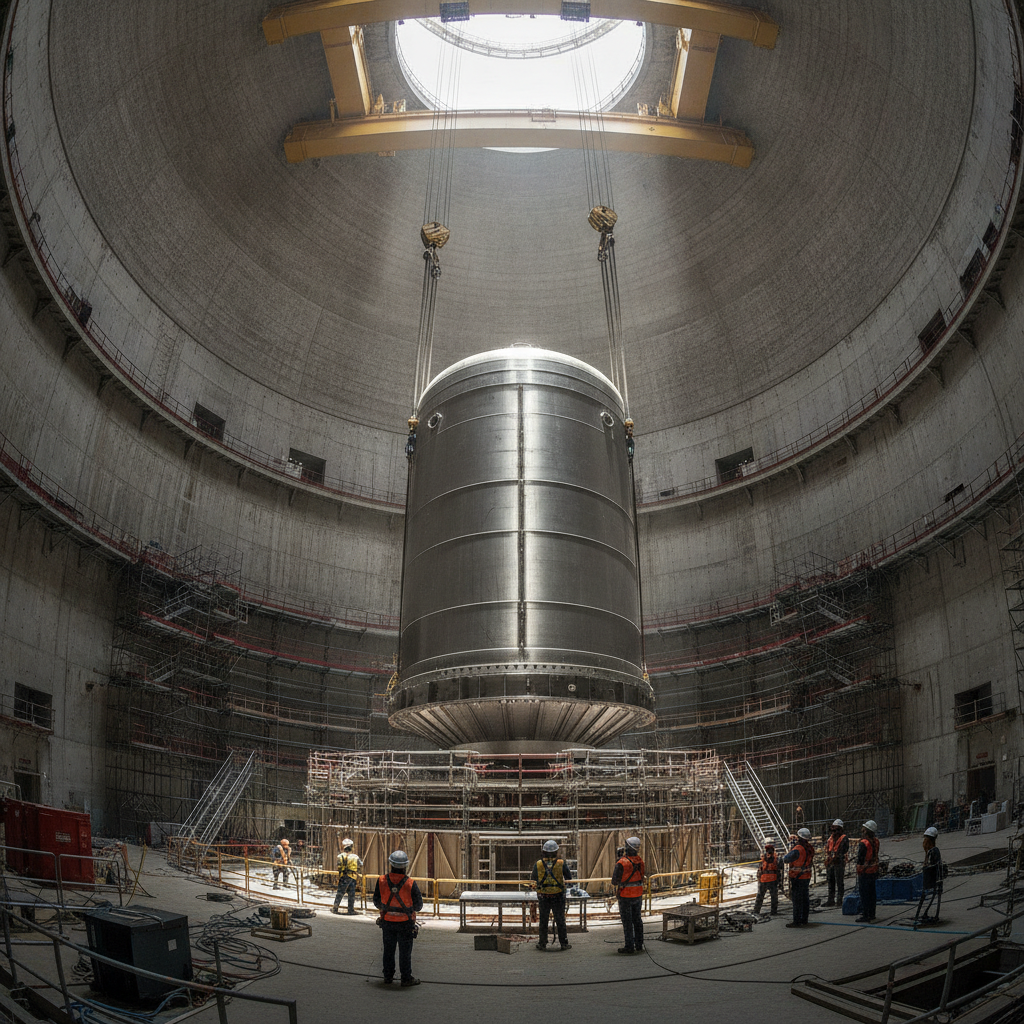
MUMBAI — On Monday, the Nuclear Power Corporation of India Limited (NPCIL) successfully installed the 320-tonne reactor pressure vessel at Unit-5 of the Kudankulam Nuclear Power Project. The installation marks a major construction milestone for one of the country's largest atomic energy complexes.
The reactor pressure vessel is considered the heart of a nuclear power plant, as it houses the reactor core where nuclear fission takes place to generate electricity. Its successful placement inside the reactor building marks the beginning of the erection of the key Nuclear Steam Supply System equipment.
According to NPCIL, the critical operation was executed after securing the Major Equipment Erection clearance from the Atomic Energy Regulatory Board. Project engineers and operators utilized specialized heavy-lift cranes to lift and position the massive vessel while strictly adhering to safety and quality protocols.
The milestone was achieved through close coordination between NPCIL and Russia's Atomstroyexport, which is associated with the project.
Once completed, the 1,000 MW Unit-5 reactor will supply round-the-clock electricity to India's power grid, helping meet the rising energy demand from households, industries, and infrastructure. Unlike renewable energy sources like solar and wind, nuclear power provides continuous generation, which officials state will strengthen energy security and reduce dependence on coal.
The Kudankulam nuclear complex, located in Tamil Nadu, is planned to house six reactors of 1,000 MW each, bringing the total capacity of the site to 6,000 MW upon full completion.
Currently, Units 1 and 2 are fully operational. NPCIL reports that these two units have already generated approximately 130 billion units of electricity since they were commissioned, preventing an estimated 112 million tonnes of carbon dioxide-equivalent emissions. Meanwhile, Units 3 and 4 are in advanced stages of construction, and Units 5 and 6 are being constructed in phases.
This development aligns with India's broader strategy to expand its non-fossil fuel energy capacity, supporting the country's long-term net-zero ambitions and clean-energy transition.